
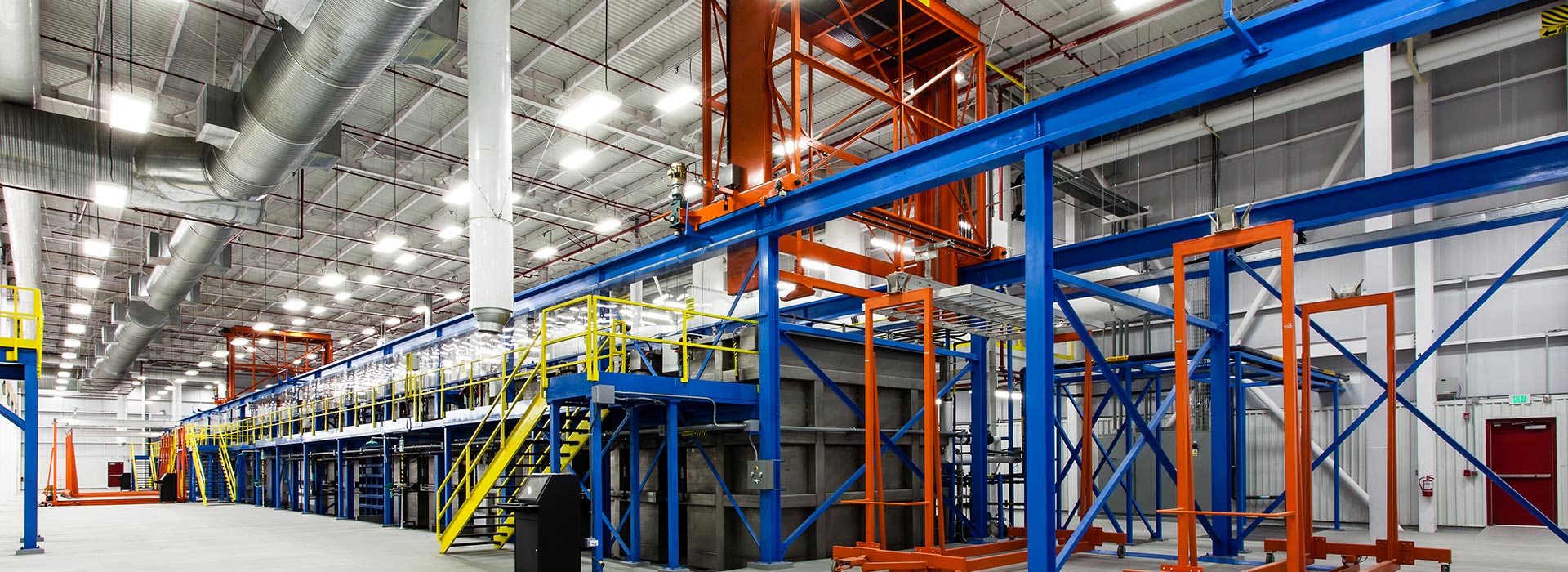
Anodizing Equipment
KOCH Finishing Systems is a world leader in the design and assembly of anodizing equipment for precision applications.
Understanding Anodizing Systems
Anodizing equipment is used to carry out controlled electrolytic oxidation to develop a tenacious aluminum oxide coating on the surface of an aluminum sheet or component. Anodizing becomes integral to its substrate by forming a protective layer that “grows down” into” the metal and provides corrosion and wear resistance, insulation, and high reflectivity.
Benefits of Anodizing
- Environmental Responsibility:
Anodizing equipment includes wastewater treatment solutions to eliminate contaminants. - Compatibility with substrates:
Anodizing equipment performs a process most often used for coating aluminum, but can also be used on magnesium, tantalum, titanium, and niobium. - Durability:
Anodize bonds with the underlying substrate to form an insulated layer that prevents corrosion or rusting caused by harsh climate conditions and chemical exposures. - Color Selection:
Most anodized surfaces allow for Electrocolor process which deposits metals into the pores of the anodic film to create a wide variety of durable colors. Anodizing creates a surface that is highly receptive to various dyes, primers, and adhesives. - Appearance:
When combined with other finishes, anodize is the only coating process that allows a metal to maintain its unique, metallic appearance.
Specialty Finishes for Anodizing
Phosphating
- Zinc phosphate can be applied to hot dipped galvanized steel prior to paint finishing, to help prevent corrosion and create natural, gray tones that settle over time.
- Manganese phosphate can be used to pretreat metals prior to paint finishing, to provide corrosion resistance caused by oil and other lubricants.
- Iron phosphate is the most popular (and most economical) pretreatment for powder coating and is compatible with virtually any substrate. Iron phosphate increases the longevity of the powder coat and protects the substrate from oxidation.
Other Processes
- Black oxide deposits a coating, formed from an aqueous salt solution to ferrous metals to minimize light reflectivity and prevent water-induced corrosion.
- Chromating deposits a chromic acid salt solution to steel, aluminum, zinc, cadmium, copper, silver, or magnesium, to form a corrosion resistant oxide layer.
- Non-Destructive Testing (NDT) utilizes a family of analysis techniques to evaluate materials or components without damage.
Explore Anodizing Processes

Type I: Chromic Acid Anodizing Equipment
is used to create a thin, protective film (.05 to .1 mils) and even finish to parts with complex geometries and crevices.

Type II: Sulfuric Acid Anodizing Equipment
is the most frequently used type of anodizing equipment. Type II: Sulfuric Acid Anodize can reach densities up to 1 mil and meets most decorative and functional requirements.

Type III: Hard Coat Anodizing Equipment
can create film densities up to 4 mils (generally Rockwell 60-70C) to enhance corrosion resistance, create a smooth finish, and provide darkest available pigmentations.

Phosphoric Acid (PAA) Equipment
creates a film that substantially enhances adhesive properties and resistance to corrosion caused by high-humidity environments.

Boric & Sulfuric Acid Anodizing (BSAA) Equipment
provides an environmentally responsible correction method for non-critical, fatigued parts that have been anodized with Type I: Chromic Acid.

Thin Film Sulfuric Acid Anodizing (TFSAA) Equipment
creates a thin, aluminum oxide film to fatigue-sensitive parts to enhance corrosion resistance and adhesive properties.

Tartaric Acid Anodizing Equipment

Chem Film Equipment
performs chromate conversion or alodine, an aluminum passivation process that provides corrosion resistance and enhances adhesion for organic coatings.

Bright Dip Anodizing Equipment
is used to perform an electro-brightening process in which a glossy, mirror-like finish is deposited onto an aluminum surface prior to the anodizing process.

Dye Penetrant Inspection
is a method for detecting surface flaws in which dye penetrant is applied to a product to reveal defects like cracks, seams, and other discontinuities.